Platforms ·
Solana’s 1,000-day milestone measures the chain, not every app
Solana passed roughly 1,000 days since its last full network halt on 2 November. The milestone concerns the validator cluster continuing to produce blocks; it does not mean every app, connection or transaction worked without interruption.
The last full stoppage was on 6 February 2024. Reporting on 2 November marked the thousand-day interval, and Solana’s official status service currently lists the mainnet cluster as operational. Its published research page also records uninterrupted network uptime since February 2024 in its September 2026 snapshot.
The distinction matters when using a wallet or exchange. A functioning chain can coexist with an unavailable app or a problem at a service that connects users to it. A cluster-uptime claim should therefore not be read as a promise that every transaction succeeds or every customer-facing service stays online.
There is a concrete example in the Foundation’s own account of an August routing failure. It says almost 29% of network stake went offline on 12 August while block production continued. That is evidence of the network absorbing a substantial infrastructure disruption, rather than evidence that no disruption occurred.
This is a reliability milestone, not a newly launched feature or a forecast for SOL’s price. For people building payments and other applications, the useful question remains how the network behaves under stress; the history is encouraging, while each application still has its own dependencies.
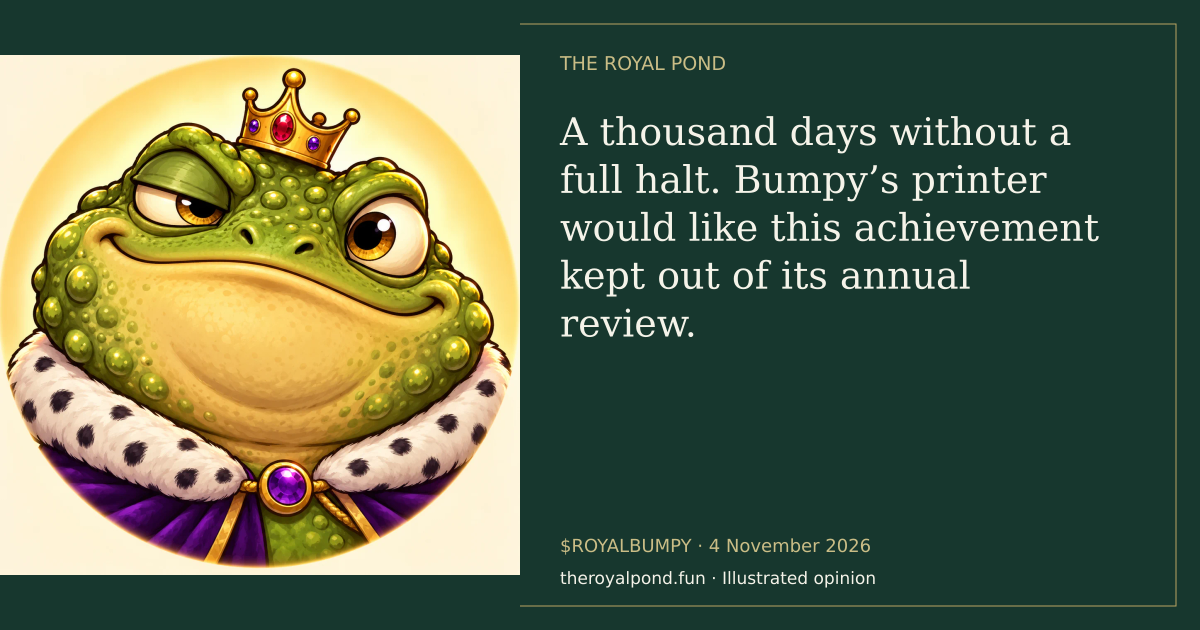
A thousand days without a full halt. Bumpy’s printer would like this achievement kept out of its annual review.
The receipts
Worth passing round?
Send the story to a friend, or take Bumpy’s verdict card with you.
Have a question about this?
Take this story into our Telegram community. Bring a source, a question or a well-placed eyebrow.
Opens the community invite. Paste the story link into the conversation; nothing is sent automatically.Follow the thread.
Earlier reporting on these topics. Dates and original assessments stay attached.

This is the 4 November 2026 edition. Facts may have developed since publication. Read the latest briefing →