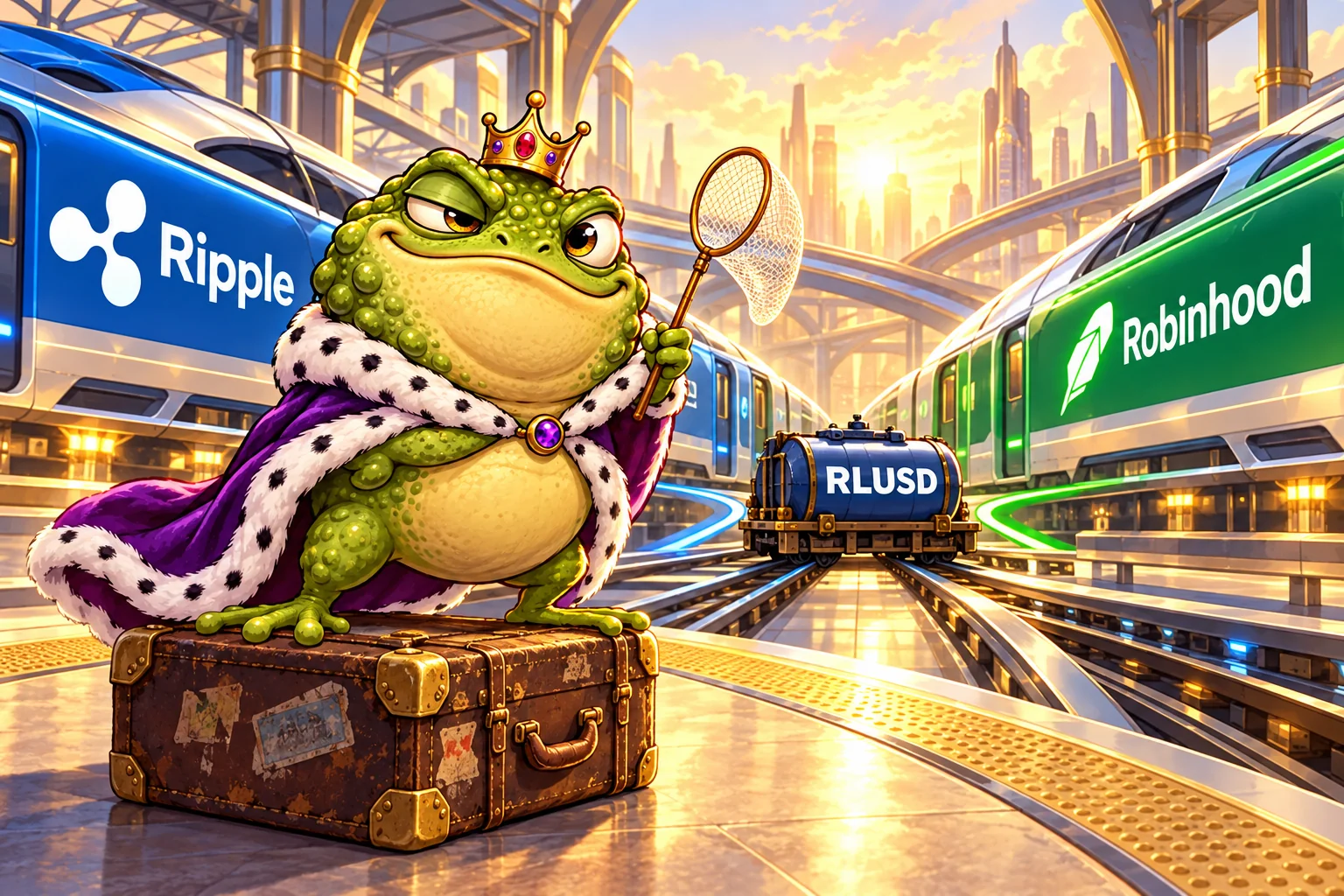
The money has a connecting train. I have a butterfly net.
Ripple and Robinhood connect more of the financial plumbing, another digital dollar gains routes through Solana and friends, and US traders acquire a market that never goes home. Meanwhile, Keystone has a much less cheerful authenticity problem. Four developments, with the announcements separated from my personal enthusiasm for standing on luggage.
Editorial illustration · 28 October 2026THE ROYAL DECREE · OPINION
A connection is not an arrival. Kindly distinguish what is running today from what is expected later this year. I have been expected to exercise for some time.
On 27 October, Ripple announced a partnership covering Robinhood’s stablecoin, treasury and institutional operations. Ripple says RLUSD is already live on Robinhood Chain and Bitstamp by Robinhood; availability in the Robinhood app is expected later in 2026. Robinhood will also integrate Ripple Treasury. This is an official company partnership, not an endorsement of independent tokens on the chain.
Zerohash announced on 27 October that Open Standard’s Open USD (OUSD) is available through its infrastructure on Base, Ethereum, Solana and Tempo. Partners can add it to account funding, treasury and payment flows through existing integrations. This is infrastructure availability, not proof that every partner has launched a consumer service; jurisdictional restrictions still apply.
Crypto.com and OG.com began rolling out crypto perpetual futures to eligible US traders on 27 October. The announcement describes non-expiring contracts, 24/7 trading, up to 5x leverage and isolated margin through their regulated derivatives infrastructure. Availability is eligibility-dependent. Regulation and risk controls do not remove the possibility of leveraged losses.
Keystone said in its 26 October statement, reported by The Hacker News, that an attacker obtained its device-verification key and exposed 25,964 buyer records. It plans to destroy 18,835 unsold devices using that key. Keystone says recovery phrases and wallet private keys were not involved; the concern is counterfeit devices passing checks. Devices received after 20 October with the old key require confirmation from Keystone support before use.