Uber gives its treasury money a weekend ride.

Uber completed a tokenised cash-management pilot with HSBC, Franklin Templeton, Tradeweb and Fireblocks on Canton. Announced on 30 October, the test combined money-market fund investment with access to funds outside traditional market hours.
In the pilot, HSBC tokenised deposits paid for Franklin Templeton tokenised money-market fund shares through Tradeweb, with Fireblocks supplying wallet infrastructure. Uber could liquidate part of the holdings over a weekend. Payment and fund-token transfers settled together, reducing the risk of one side completing without the other.
The business problem is ordinary: companies need cash for payments even when conventional investment and banking workflows are closed. Keeping a larger cash buffer available can mean leaving less money invested. The partners say their test demonstrated a way to reduce that tension.
This was a corporate treasury demonstration, not an announcement that passengers can pay for rides with crypto or that drivers will receive tokens. Wider deployment, commercial terms and measured savings were not established by the announcement.
The distinction between the assets also matters. A tokenised bank deposit and a money-market fund share represent different claims. The fund disclosure warns that its value is not guaranteed and it is not a bank deposit. Putting the workflow on a blockchain does not erase those differences.
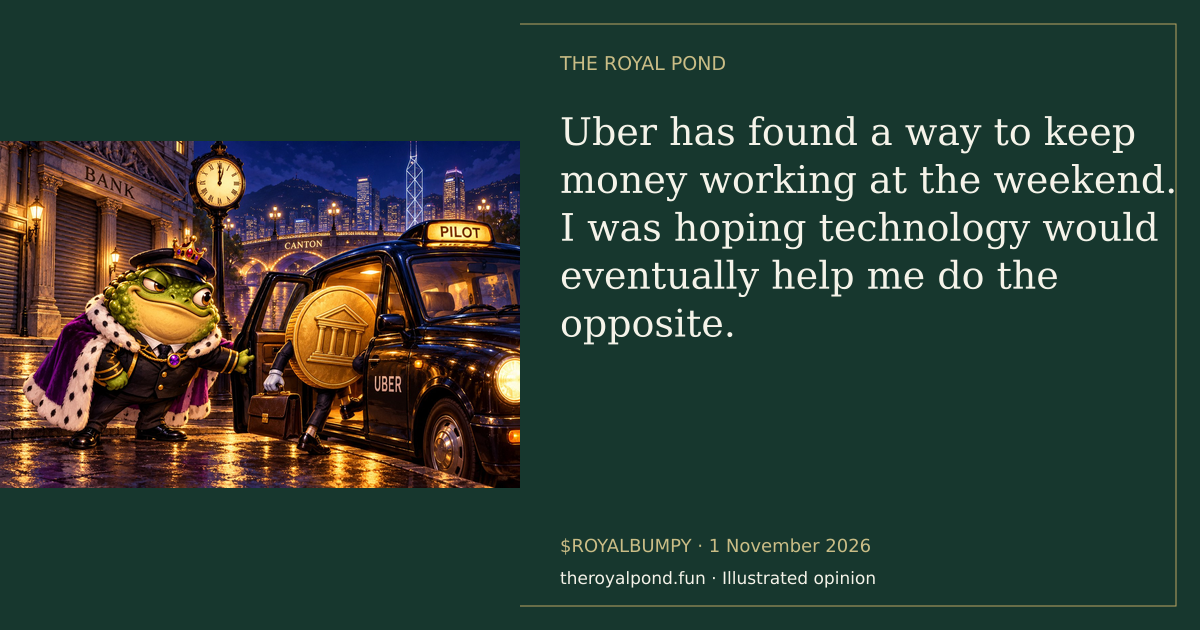
Uber has found a way to keep money working at the weekend. I was hoping technology would eventually help me do the opposite.
The receipts
Worth passing round?
Send the story to a friend, or take Bumpy’s illustrated verdict with you.
Have a question about this?
Take this story into our Telegram community. Bring a source, a question or a well-placed eyebrow.
Opens the community invite. Paste the story link into the conversation; nothing is sent automatically.This is the 1 November 2026 edition. Facts may have developed since publication. Read the latest briefing →